What is MiCA
MiCA (Markets in Crypto-Assets) is Regulation (EU) 2023/1114 on markets in crypto-assets. It was adopted in 2023 and has applied in full since 30 December 2024. It is a regulation, not a directive: its rules apply directly in every member state and do not need to be transposed into national law.
Before MiCA, each country regulated the crypto market in its own way. Some only required registration for anti-money-laundering purposes, some ran their own licensing regimes, and some had no rules at all. A company wanting to operate in several countries had to go through several different procedures. MiCA replaced this patchwork with a single standard.
The regulation covers crypto-assets that fall outside existing financial legislation. Tokenised shares or bonds remain subject to MiFID II. MiCA divides crypto-assets into three groups:
- EMTs (e-money tokens). Pegged to a single official currency, such as the euro or the dollar. These are classic fiat stablecoins.
- ARTs (asset-referenced tokens). Maintain their value by reference to a basket of currencies, commodities or other crypto-assets.
- Other crypto-assets. Everything that is not an EMT or ART, including utility tokens. The main requirement for them is publishing a white paper.
A single licence and "passport" for CASPs
The central concept of MiCA is the CASP (crypto-asset service provider). These are exchanges, exchange services, custodial wallets, brokers, transfer platforms, as well as firms that advise on crypto-assets or manage portfolios.
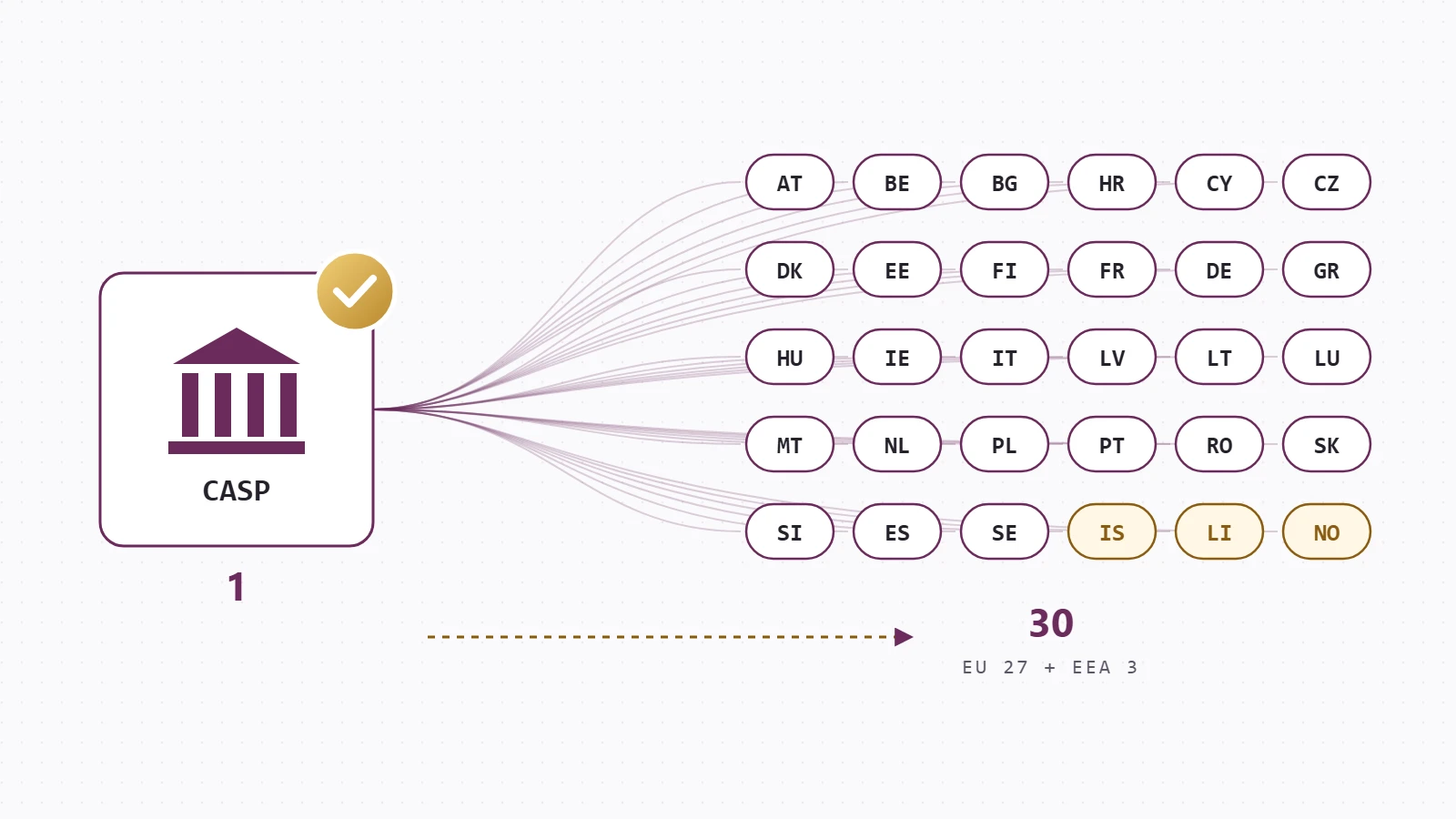
A CASP obtains a licence from the national regulator of one EU country. That licence then works as a "passport": the company simply notifies the regulator and can serve clients in every member state. Once the regulation is incorporated into the EEA Agreement, Iceland, Liechtenstein and Norway join this space too.
The licence is not automatic. The regulator checks the business against a list of requirements:
- Capital. Minimum prudential requirements of 50,000 to 150,000 euros depending on the type of service.
- Governance. Good repute and competence of management, a transparent ownership structure and a conflict-of-interest policy.
- Client assets. Clients' crypto-assets and funds are held separately from the company's own assets.
- Cyber security. IT system requirements, complemented for CASPs by the DORA regulation on digital operational resilience.
The list of licensed firms is published by the European markets regulator ESMA in its MiCA register. Clients can check whether a platform is allowed to operate in the EU.
Stablecoins under special scrutiny
MiCA's strictest rules apply to stablecoins. The logic is simple: if a token claims to be money, it must be as reliable as money. We covered how fast this market is growing in our review of how stablecoins are reshaping the payments market.
- Who may issue. Only a bank or an e-money institution licensed in the EU may issue EMTs.
- Redemption at par. Holders have the right to exchange the token for fiat at par at any time and free of charge.
- Reserves. Reserve assets must be liquid and segregated. Part of the reserves is held as bank deposits.
- No interest. Paying interest to EMT and ART holders is prohibited, for both issuers and CASPs.
- Significant tokens. Large stablecoins are classified as "significant" and come under the supervision of the European Banking Authority (EBA).
The practical effect was already visible in 2025. A number of major platforms restricted EEA users from trading stablecoins whose issuers had not obtained MiCA authorisation. At the same time, interest grew in euro-denominated stablecoins issued by licensed European institutions.
Investor protection and market integrity
MiCA brings to crypto the principles long familiar from the securities market. The main one: investors must know what they are buying.
- White paper. A public offer of a token requires a document setting out the risks, holders' rights and a description of the project.
- Fair marketing. Marketing must be clear, not misleading and consistent with the white paper.
- Right of withdrawal. A retail buyer can withdraw from a token purchase made in an offer within 14 days without giving a reason.
- Market abuse. Insider dealing and manipulation are prohibited, and platforms must detect and report suspicious transactions.
Alongside MiCA, the recast Regulation (EU) 2023/1113 — the so-called travel rule — has applied since 30 December 2024. Every crypto transfer between CASPs is accompanied by information on the sender and recipient, with no minimum threshold.
The transitional period is over: what it means
For companies that operated under national rules before 30 December 2024, MiCA allowed a transitional period of up to 18 months, that is, no later than 1 July 2026. Some states shortened this to 6–12 months. The transitional period has now ended everywhere: without a MiCA licence, serving clients in the EU is not allowed.
The market responded with consolidation. Large players obtained licences in one country and passported them across the EU. Smaller firms sold their business, merged or left the market. Supervisors are also watching to ensure individual countries do not become "light-touch" jurisdictions for quick licences. ESMA has publicly pointed to licensing shortcomings in certain states, and the European Commission has proposed strengthening ESMA's role in supervising the largest CASPs.
What it means for Ukrainian companies
For Ukrainian fintech, MiCA is both a barrier and an opportunity. European clients can only be served through a licensed structure in the EU. Arguing that a client "found the service on their own" will not help: regulators interpret the reverse solicitation exemption very narrowly.
On the other hand, as part of European integration, Ukraine is preparing its own virtual-asset regulation modelled on MiCA. Companies that build their processes to European standards now will have an advantage as national rules converge with EU ones.
In brief: frequently asked questions
Do you need a MiCA licence to serve clients in the EU?
Yes, if the company provides crypto-asset services to clients in the EU. The reverse solicitation exemption is interpreted very narrowly and does not work for a systematic business.
Does MiCA regulate bitcoin?
MiCA regulates services involving bitcoin: exchange, custody and trading. Bitcoin itself has no issuer, so the white paper requirement does not apply to it.
Does MiCA cover NFTs and DeFi?
Unique NFTs and fully decentralised services without an intermediary are largely outside the scope of the regulation. The European Commission is to assess whether separate rules are needed for them.